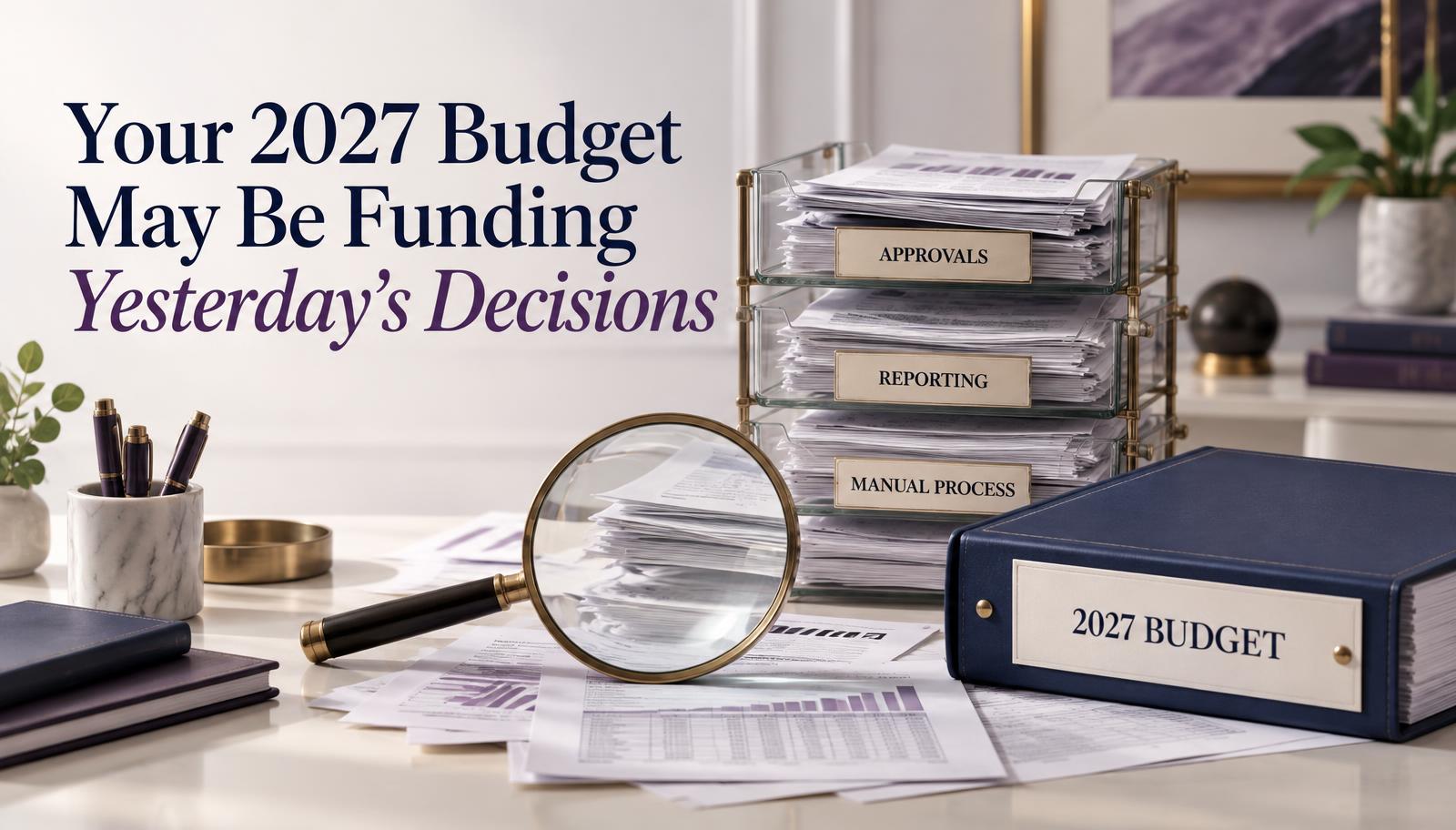
Your 2027 Budget May Be FundingYesterday's Decisions
Before cutting next year's budget, take a closer look at what you're still paying to maintain.
I've been thinking about something as organizations prepare their budgets for 2027.
How much of next year's spending is supporting the business we're trying to become?
And how much is supporting the way we used to operate?
Because those aren't necessarily the same thing.
Every organization carries decisions forward.
Some are deliberate.
Some are necessary.
And some?
Well, they've been around so long they're practically part of the furniture.
Nobody really questions them anymore.
But somebody is still paying for them.
The cost of keeping things comfortable
Think about how processes evolve.
A company introduces an extra approval because something went wrong.
A team creates a spreadsheet because two systems don't communicate.
Another department starts producing a report because leadership requested it.
At the time, each decision makes sense.
But then circumstances change.
Systems improve.
Customers evolve.
Responsibilities shift.
And somehow, the work remains.
Sometimes the original problem disappeared years ago.
The process didn't.
Now the organization has employees, systems, and budgets supporting activities that may no longer create the same value.
And because those costs are spread across departments, nobody sees the full picture.
The interesting thing about operating costs
Not every unnecessary expense shows up as a line item labeled "unnecessary expense."
Wouldn't that be convenient?
Instead, it appears as:
Extra handling.
Repeated reviews.
Manual corrections.
Duplicate reporting.
Additional coordination.
Premium freight.
Time spent resolving the same exceptions.
The business may classify these costs in completely different places.
But operationally, they may be connected.
And that's why simply reviewing the budget by department may not reveal the underlying problem.
Sometimes the cost isn't sitting in the budget. It's built into the way the work gets done.
What would you find if you followed the work?
Imagine a business with 30 employees spending an average of two hours each week maintaining a recurring manual process.
That's 60 hours every week.
Over 48 working weeks, it's 2,880 hours annually.
At an illustrative loaded labor rate of $60 per hour, that's $172,800 in annual labor capacity.
- Employees
- 30
- Hours per employee per week
- 2
- Working weeks annually
- 48
- Annual labor hours
- 2,880
- Illustrative loaded hourly rate
- $60
- Illustrative annual labor capacity
- $172,800
30 employees × 2 hours × 48 working weeks = 2,880 hours; 2,880 × $60 = $172,800 in illustrative annual labor capacity. This hypothetical estimate is not realized savings. Budget impact depends on eliminating work, actually reducing staffing expenses, or redirecting capacity toward more valuable outcomes.
Does that mean the business could immediately remove $172,800 from its budget?
No.
Not necessarily.
It depends on whether the work can be eliminated, staffing expenses actually reduced, or capacity redirected toward something more valuable.
But I'd still want to understand why those 2,880 hours are being spent.
What business requirement does the process satisfy?
Is that requirement still valid?
What risk would we introduce by changing it?
And could we achieve the same result another way?
Those are the questions that turn a cost discussion into an operating-model discussion.
Be careful what you eliminate
There's another side to this.
Not every manual process is waste.
Sometimes the activity that looks inefficient is where employees recognize exceptions, develop judgment, or protect customer relationships.
Remove the task without understanding its purpose, and you may remove something valuable.
That's why I wouldn't start with a list of activities to eliminate.
I'd start with the business outcomes those activities are supposed to support.
Then I'd examine whether the current process is still the best way to achieve them.
Because reducing cost at the expense of business stability isn't necessarily an improvement.
It may simply move the cost somewhere else.
A different conversation for 2027
When leaders talk about improving profitability, I often hear questions about where spending can be reduced.
Fair question.
But I'd add a few more.
What are we paying for because two functions aren't coordinated?
Which recurring exceptions have become accepted operating expenses?
Where are employees compensating for process or system limitations?
Which activities still exist because of decisions made under conditions that no longer apply?
And what would it take to change them without losing critical knowledge or controls?
These questions may reveal opportunities that a traditional budget review misses.
This is the work behind PRISM
PRISM examines the patterns and operating conditions that influence business performance.
Sometimes that means identifying emerging revenue risk.
Sometimes it means recognizing instability before it affects customers.
And sometimes it means understanding why an organization continues to absorb costs that have become normal.
The objective isn't to label every workaround as waste.
It's to understand what the workaround is telling us.
And whether the business should still need it.
One question before finalizing the budget
If you were designing your organization for 2027, with today's technology, customer expectations, and business priorities, what would you build differently?
Now comes the harder question.
What's stopping you from changing it?
Because improving next year's bottom line may not begin with another cost-cutting initiative.
It may begin with understanding which costs the organization has learned to accept.
And whether those costs still belong in the business.
The free PRISM Signal Scan™ offers a starting point for identifying operational conditions that may deserve a closer look.
PRISM SignalWorks™ | Organizational Intelligence
What signal does this raise in your organization?
Share what you're seeing. Every response is read and approved by Rhonda before it appears.
Loading responses…
What Is Your 2027 Budget Still Paying to Maintain?
Some operating costs are tied to processes and decisions that deserve another look. Start identifying the organizational signals that may reveal opportunities for improvement.
Free PRISM Signal Scan™