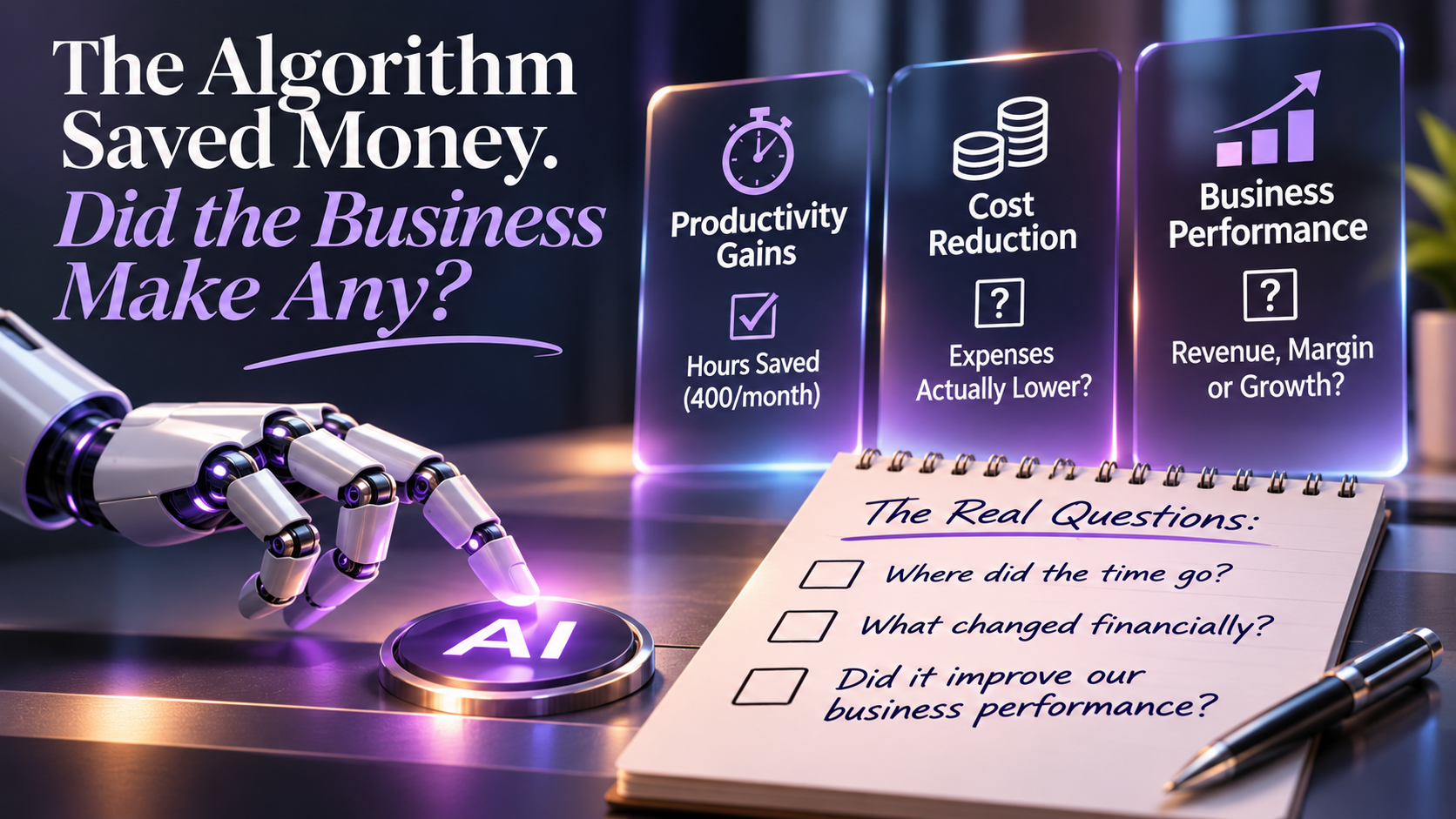
The Algorithm Saved Money.Did the Business Make Any?
Before celebrating AI productivity, make sure the financial benefit actually reached the business.
I keep seeing conversations about how much time AI is saving.
Ten hours a week.
Hundreds of tasks automated.
Thousands of documents processed.
Impressive.
But I have another question.
What did the business actually gain?
Because saving time and improving profitability are not automatically the same thing.
And I think we're going to need a much better understanding of that distinction as organizations increase their AI investments in 2027.
The productivity celebration
Imagine a company introduces an AI assistant to support its customer operations team.
The results look great.
Employees spend less time searching for information.
Routine responses are drafted faster.
Manual reporting takes fewer hours.
The team estimates that the technology saves 400 hours every month.
That's worth celebrating.
But before we turn those hours into a financial success story, I'd want to know what happened next.
Did operating expenses decrease?
Did employees use that capacity to manage more business?
Did service improve?
Did the organization reduce costly errors?
Did the additional capacity help protect revenue or create profitable growth?
Or did we simply make the same work easier?
Now, there's nothing wrong with making work easier.
I happen to think that's a very good thing.
But we should be clear about what kind of value we've created.
Let's put a number on it
Suppose an AI solution saves 400 employee hours per month.
At an illustrative loaded labor rate of $55 per hour, that's $22,000 in monthly labor capacity.
Or $264,000 annually.
- Hours saved per month
- 400
- Illustrative loaded hourly rate
- $55
- Monthly capacity value
- $22,000
- Annual capacity value
- $264,000
Hypothetical capacity estimate: 400 hours × $55 = $22,000 per month; $22,000 × 12 = $264,000 annually. These figures estimate available labor capacity, not realized cash savings.
Sounds like a substantial return.
Except we haven't calculated the return yet.
We've estimated the value of time made available.
If the company maintains the same staffing costs, those hours don't automatically become $264,000 in cash savings.
The capacity might allow the team to handle more volume without hiring.
It might improve responsiveness.
It might support additional sales activity.
Or it might simply reduce pressure on employees.
All potentially valuable outcomes.
But they need different measures.
Capacity created is not the same as cost removed.
And neither automatically tells us whether profitability improved.
The value might be somewhere else
Here's where I think organizations could be missing an opportunity.
What if the biggest benefit of AI isn't the task it eliminates?
What if it's what employees can accomplish with the time they get back?
A customer engagement specialist who spends less time searching for order information may have more time to recognize changes in customer demand.
A sales professional who spends less time preparing reports may have more time to develop opportunities.
An operations analyst who spends less time consolidating spreadsheets may have more time to investigate recurring exceptions.
Now we're talking about something different.
Not just productivity.
Business performance.
But there's a catch.
The organization has to deliberately redirect that capacity.
Otherwise, the time savings may never become a measurable business outcome.
The questions I'd ask before approving another AI investment
I'd want to separate three kinds of value.
How much time or effort does the technology release?
What actual expenses are reduced, additional contribution generated, or future costs avoided?
Does the technology help people make better decisions, recognize risk sooner, or act on opportunities they previously missed?
That third category interests me.
Because an organization can automate a thousand activities and still struggle to recognize the one customer issue that threatens a major account.
Or the recurring operational problem that's quietly eroding margin.
Or the demand change that should influence next quarter's forecast.
Those outcomes won't necessarily show up in a time-savings dashboard.
But they may have a much greater financial impact.
There's also the cost of getting it wrong
Faster work isn't always better work.
If AI produces recommendations using incomplete information, the business may create new risks while reducing effort.
An automated purchasing recommendation may lower inventory costs but increase the chance of a service disruption.
A faster customer response may be technically accurate but overlook an important commercial commitment.
An automated workflow may reduce processing time while making an existing process problem harder to recognize.
The point isn't to slow down AI adoption.
It's to make sure the organization understands what it's accelerating.
Where PRISM fits
At PRISM SignalWorks™, I look beyond the technology itself.
What is the organization trying to improve?
What patterns or risks affect that outcome?
What information is missing?
And what needs to change operationally for the technology to deliver measurable value?
Because installing an AI solution is not the same as redesigning how the business works.
And productivity metrics are not the same as financial results.
Before you approve the 2027 AI budget
I'd ask one question:
If this technology performs exactly as promised, what will actually change on our income statement, in our customer relationships, or in our ability to grow?
If we can't explain that clearly, we may be measuring the wrong success.
AI should do more than help organizations work faster.
It should help them perform better.
And the difference deserves to be measured.
The free PRISM Signal Scan™ can help begin the conversation about operational conditions that may limit the value of technology investments.
PRISM SignalWorks™ | Organizational Intelligence
If this technology performs exactly as promised, what will actually change on our income statement, in our customer relationships, or in our ability to grow?
Share what you're seeing. Every response is read and approved by Rhonda before it appears.
Loading responses…
Is Your AI Investment Creating Business Value?
Before expanding your 2027 AI budget, examine the operational conditions that influence whether productivity improvements become measurable business results.
Free PRISM Signal Scan™